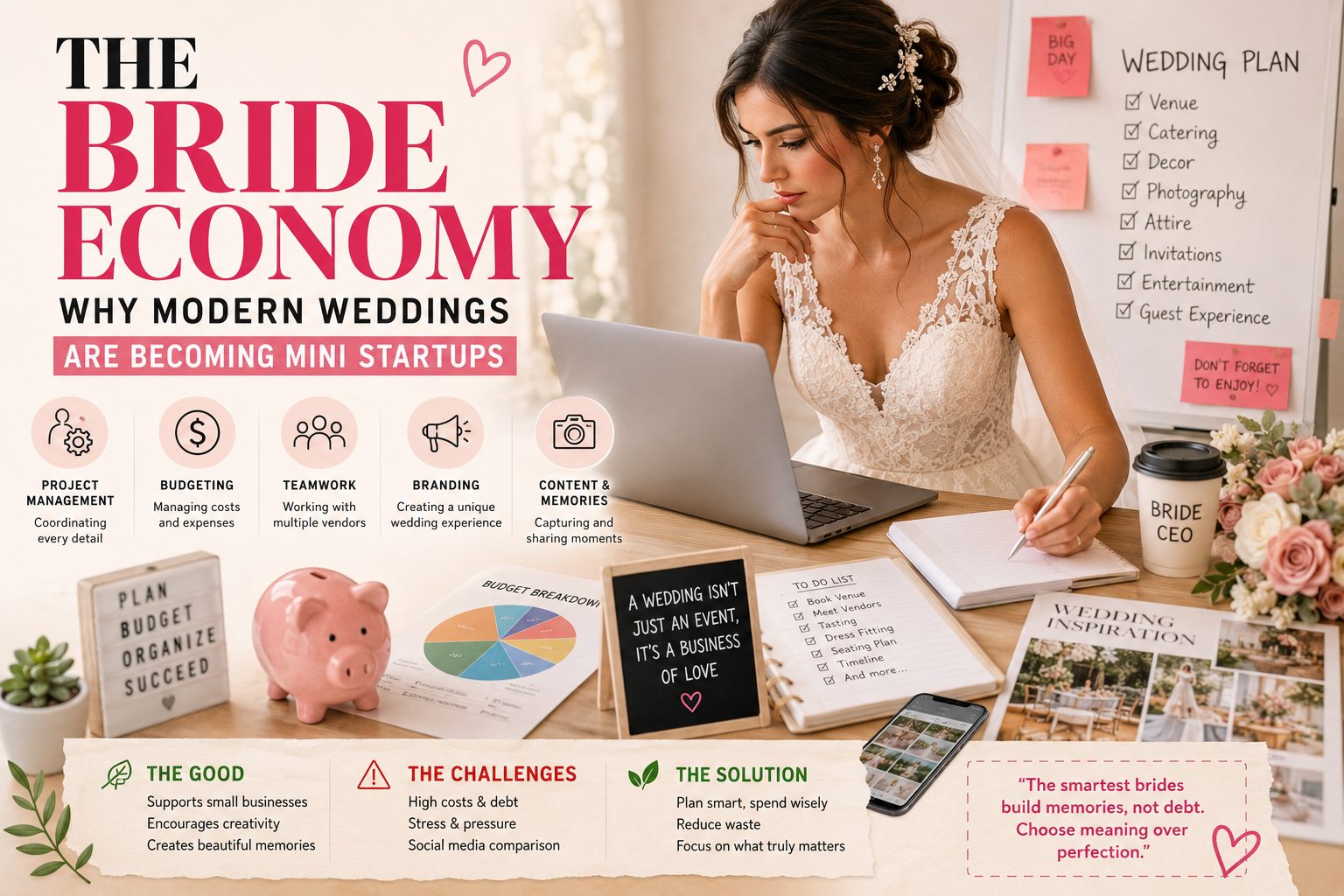
A wedding was once described as a family celebration. Today, it often looks more like a temporary company built around one emotional deadline. There is a budget, a team, a brand identity, a guest experience plan, a photography strategy, a content schedule, and a final launch day. At the center of it all is the bride, not just choosing flowers or a dress, but managing a small economy around one of the most personal events of her life.
This is the rise of what can be called the Bride Economy.
The phrase may sound new, but the reality is already visible everywhere. Modern weddings are no longer only about ceremony and tradition. They are about planning, presentation, social media, vendor coordination, personal branding, family expectations, and financial decision-making. A bride today may deal with photographers, makeup artists, decorators, venues, caterers, fashion designers, travel plans, invitation designers, content creators, and sometimes even PR-style storytelling for social media.
That is why the modern bride often behaves like a startup founder.
According to The Knot’s Real Weddings Study, the average wedding cost in the United States reached around $34,000 for couples married in 2025. The Knot also reported that weddings continue to represent a major part of the U.S. celebration economy, with millions of couples spending on venues, food, photography, fashion, and guest experiences. The global wedding services market is also growing, with Fortune Business Insights estimating it at more than $650 billion in 2024. These numbers show that weddings are not just emotional events. They are serious economic engines.
But behind those numbers is a very human story.
For many brides, wedding planning starts with excitement. There is the dream dress, the perfect venue, the mood board, the music, the photos, and the hope that everything will feel beautiful. But slowly, the dream becomes a project. Every choice has a price. Every delay creates pressure. Every family opinion adds another layer. Every social media post from another wedding can make the bride question her own plan.
This is where the Bride Economy becomes powerful and stressful at the same time.
The good side is clear. Weddings support thousands of small businesses. Makeup artists, photographers, decorators, tailors, caterers, florists, planners, designers, and venues all depend on wedding spending. A single wedding can create income for many people. In that sense, a bride is not only planning a personal event. She is activating a temporary business network.
There is also creativity. Many brides now design weddings that reflect their personality, culture, values, and story. Some choose small intimate weddings. Some choose sustainable décor. Some choose digital invitations. Some support local designers instead of mass-produced fashion. The modern wedding can be a place where personal identity and small business creativity meet.
But the bad side cannot be ignored.
The pressure to create a “perfect wedding” can turn love into performance. Social media has made weddings more visible than ever. A bride may feel that her wedding must look beautiful not only in real life, but also on Instagram, TikTok, and photo albums. The event becomes something to experience and something to display. That double pressure can make the planning process emotionally heavy.
Money is another major issue. A wedding budget can grow quietly. First, the couple chooses a venue. Then comes food, dress, makeup, photography, decoration, transport, gifts, entertainment, and extra events. Small upgrades feel harmless one by one, but together they can create serious financial pressure. For some couples, the wedding becomes the first big financial test before married life even begins.
The environment also pays a price.
Large weddings can create food waste, plastic waste, flower waste, fabric waste, and high travel emissions. The U.S. Environmental Protection Agency has warned that food waste has major environmental impacts, including greenhouse gas emissions, wasted water, wasted energy, and wasted land resources. When a wedding serves more food than guests can eat, the waste is not just a catering issue. It becomes part of a larger environmental problem.
This does not mean weddings are bad. It means weddings need smarter planning.
A better Bride Economy would not be about spending more. It would be about spending with purpose. Brides and couples can reduce waste by choosing accurate guest counts, donating safe leftover food where possible, renting décor, using reusable materials, selecting local vendors, choosing seasonal flowers, and avoiding unnecessary single-use items. A beautiful wedding does not need to be wasteful.
The future of weddings may belong to brides who think like creative founders, but also like responsible leaders. They will ask better questions. Do we need this, or do we only want it for photos? Can this item be reused? Can we support local businesses? Can we reduce food waste? Can we create a memorable event without creating unnecessary debt?
That is the real shift.
The Bride Economy is not only about expensive dresses or luxury venues. It is about how modern weddings have become emotional startups. They are built with money, people, creativity, pressure, and risk. They can support businesses, create memories, and celebrate love. But they can also create stress, debt, comparison, and waste.
A wedding should not feel like a business competition. It should feel like the beginning of a life. The smartest brides of the future may not be the ones who spend the most. They may be the ones who plan with beauty, balance, and meaning.