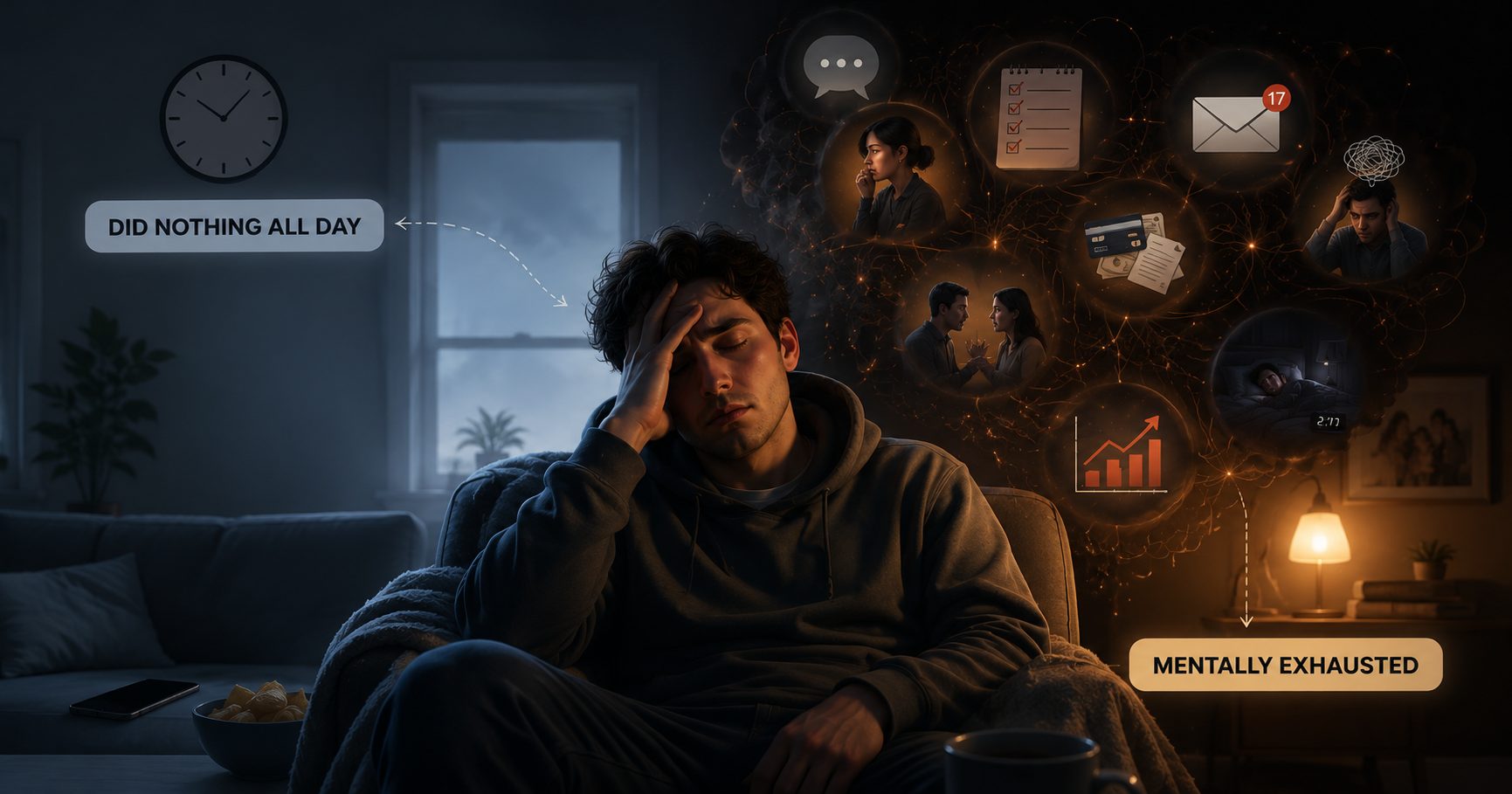
It was a Tuesday. I had not gone to the gym. I had not moved furniture or run errands or done anything that should have left me tired. I sat at my desk, attended two video calls, scrolled through my phone more than I care to admit, and made roughly forty small decisions about things that did not particularly matter.
By 6pm I was exhausted. Not sleepy-exhausted. The kind of tired that sits behind your eyes and makes the idea of cooking dinner feel like climbing a mountain.
I remember thinking: what is wrong with me? I did nothing today.
That thought, it turns out, was the problem. I had done quite a lot. It just was not the kind of doing that leaves a visible mark.
Mental exhaustion is not laziness
There is a version of tiredness that has nothing to do with your body and everything to do with your mind. It does not come from lifting things or running anywhere. It comes from thinking, deciding, managing emotions, and staying alert — all day, every day, whether you notice it or not.
Most of us have been taught to measure tiredness by physical output. If you did not sweat, you did not earn your fatigue. That is simply not how the brain works.
Your brain consumes a significant portion of your body’s energy even at rest. When you add decision-making, emotional processing, and the background hum of modern life on top of that — notifications, news, social comparison, low-level worry — the energy drain is real, even if it is invisible.
The first reason: decision fatigue
Every decision you make, no matter how small, draws on the same mental resource. What to eat. Which email to answer first. Whether to reply to that message now or later. What to watch tonight. Which route to take. What to say in a conversation you are slightly dreading.
None of these decisions feel significant on their own. Together, across a full day, they add up to something genuinely draining. By the time evening arrives, even simple choices can feel disproportionately hard — not because you are weak, but because that decision-making resource has been spent.
I noticed this most clearly on days when I had no structure. Paradoxically, a day with no set plans often left me more tired than a day with a full schedule, because every hour required a fresh decision about what to do with it.
The second reason: emotional labour
Emotional labour is the work of managing your feelings in order to function in your relationships and your day.
This includes: staying patient in a frustrating conversation. Being cheerful when you do not feel it. Listening carefully when your own thoughts are loud. Saying the right thing at the right moment. Not saying the thing you want to say.
None of this is visible. None of it counts as doing something in the traditional sense. But it costs real energy, and for many people it is happening almost constantly — at work, in families, in friendships, online.
A day full of emotional labour can leave you just as tired as a day full of physical work. The difference is that at the end of a physical day you have something to point to. At the end of an emotionally demanding day you just feel flat, and you do not always know why.
The third reason: background anxiety
This one is the quietest and possibly the most draining of all.
Background anxiety is not a panic attack or an obvious worry. It is the low-level hum of unresolved things sitting at the edge of your awareness. The email you have not replied to. The conversation you need to have. The bill you have been avoiding looking at. The plan you have not made yet.
Your brain does not switch off awareness of these things just because you are not actively thinking about them. They occupy a kind of mental background processing — running quietly, consuming energy, surfacing occasionally to remind you they exist, then retreating again without being resolved.
A day that looks empty on paper can be full of this background processing. And it is exhausting in a way that is very hard to explain to someone else.
4 habits that genuinely helped me
I want to be clear that these are things that worked for me personally. Everyone is different, and if your exhaustion feels overwhelming or persistent, speaking to a doctor is always the right call.
Reduce small decisions before the day starts. I started deciding the night before what I would eat for breakfast and what my first task would be in the morning. Removing even two or three decisions from the start of the day made the mornings feel lighter. It sounds almost too simple to work. It worked.
Give yourself a proper emotional off-ramp in the evening. For me this was 20 minutes of something that required no decisions and no emotional output — a specific playlist, a short walk with no destination, a television programme I had seen before. The key was that it asked nothing of me. This became the mental version of taking off work clothes when you get home.
Write down the background things. Once I started keeping a simple running list of unresolved things — not a complicated system, just a notes page on my phone — I noticed the background hum got quieter. Getting something out of your head and onto a page does not solve it, but it tells your brain it has been registered and can stop alerting you for now.
Protect at least one hour of genuine rest. Not rest while also scrolling. Not rest while also half-watching something and half-thinking about something else. One hour of doing something that genuinely absorbs your attention without demanding anything in return. Reading works for me. A long shower. Cooking something simple. The activity matters less than the quality of the rest.
You are not lazy
The version of you that sits down at the end of a day that looked unproductive and feels completely drained is not failing. They have spent hours making decisions, managing emotions, and carrying the quiet weight of everything unfinished.
That is real work, even when it leaves no visible evidence.
The tiredness makes sense. And the good news is that once you understand where it is coming from, small changes to how you structure your day can make a meaningful difference — not overnight, but steadily, over time.
Start with one thing tonight. Just one.