I used to think procrastination only happened with boring things.
Assignments. Cleaning. Paperwork. Emails I did not want to answer. Those made sense to me. Of course I delayed them. They were not fun.
But the kind of procrastination that confused me most was different. It happened with things I actually wanted to do.
For me, it was starting a personal blog.
I wanted it badly. I had ideas saved in my notes app. I had titles written down. I imagined publishing posts, building an audience, and finally having a place where my thoughts could live outside my head.
But every time I sat down to write the first post, I found a reason not to.
I told myself I needed a better website design first. Then I needed to research more. Then I needed to choose the perfect niche. Then I needed to read other blogs to “understand the market.” Somehow, after two hours, I had watched videos, checked social media, changed my font three times, and written exactly zero words.
The strange part was that nobody was forcing me to do it. It was my goal. My dream. My idea.
So why was I avoiding it?
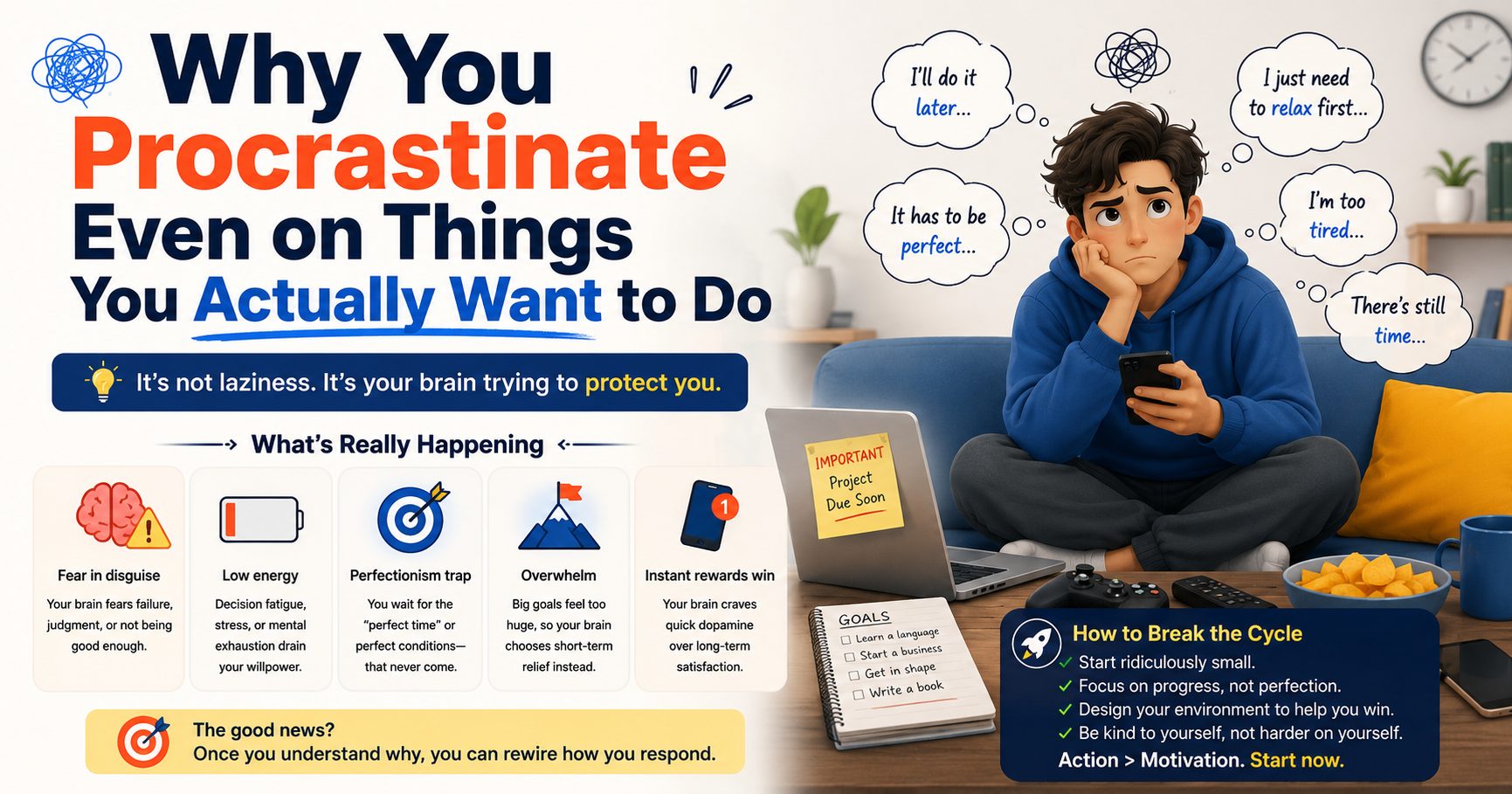
Over time, I realized something important: procrastination is not always about laziness. Sometimes it is about fear. Sometimes it is about pressure. Sometimes it is your brain choosing short-term comfort over long-term happiness.
And once I understood that, I stopped hating myself for procrastinating and started working with myself instead.
I Was Not Avoiding the Goal. I Was Avoiding the Feeling.
When I thought about writing my first blog post, I felt excited for maybe five seconds.
Then the fear arrived.
What if nobody reads it?
What if people read it and think it is bad?
What if I start and cannot stay consistent?
What if I realize I am not as good as I thought?
That last one was the real fear.
As long as the blog stayed in my imagination, it could be perfect. It could become successful. It could be “something I’m going to do soon.”
But once I actually started, the fantasy had to meet reality. The first post might be average. The website might look simple. The writing might not sound as powerful as it sounded in my head.
So I delayed it.
Not because I did not care, but because I cared too much.
That is the uncomfortable truth about procrastinating on goals. The more personal the goal is, the scarier it can feel to begin.
Fear of Failure Makes Starting Feel Dangerous
One thing I found while reading about procrastination is that fear of failure comes up again and again.
The American Psychological Association has discussed procrastination as something connected to short-term mood repair. In simple words, we avoid a task because avoiding it makes us feel better right now.
That made perfect sense to me.
When I avoided writing, I felt relief. I did not have to face the blank page. I did not have to judge my own work. I did not have to risk being disappointed.
But that relief never lasted.
A few hours later, I felt guilty. Then I felt behind. Then the goal started feeling heavier. The next day, starting felt even harder.
That is the trap. Procrastination gives you comfort now, but it charges interest later.
Reddit discussions in communities like r/productivity and r/getdisciplined show the same pattern in real life. People often say they procrastinate not because they hate their goals, but because they are scared of doing them badly. Some delay learning coding, starting YouTube, applying for jobs, going to the gym, or launching a project because beginning makes the possibility of failure real.
I related to that deeply.
Perfectionism Pretends to Be High Standards
For a long time, I thought perfectionism meant caring about quality.
But now I think perfectionism is often fear wearing a nice outfit.
When I delayed my blog, I told myself I had high standards. I wanted the design to be clean. I wanted the first post to be meaningful. I wanted the name to be perfect.
But honestly, I was hiding.
Perfectionism gave me a respectable excuse to not start. I could say, “I’m still preparing,” when the truth was, “I’m scared this will not be good enough.”
Research published in Frontiers in Psychology connects procrastination with perfectionism and fear of failure. The basic idea is simple: when people feel that mistakes are unacceptable, starting becomes emotionally risky.
That is exactly how it felt.
If I wrote nothing, I could still believe I had potential. But if I wrote something imperfect, I had proof that I was not perfect.
That sounds dramatic, but many people do this quietly. We protect the dream by not testing it.
Your Brain Likes Short-Term Comfort
Another thing that helped me understand myself was this: the brain loves immediate comfort.
Writing a blog post gives long-term satisfaction. Scrolling gives instant comfort.
Building a habit gives long-term confidence. Watching one more video gives instant ease.
Working on a goal gives future pride. Avoiding it gives present relief.
The problem is that the present version of us is loud. The future version of us is quiet.
In the moment, the brain often chooses whatever removes discomfort fastest. If opening the laptop makes me feel pressure, and checking my phone makes me feel relaxed, my brain naturally pulls me toward the phone.
This does not mean I am weak. It means my brain is trying to protect me from discomfort, even when that discomfort is necessary for growth.
Once I saw procrastination this way, I stopped asking, “Why am I so lazy?”
I started asking, “What feeling am I trying to avoid?”
That question changed everything.
The First Thing That Helped: Making the First Step Tiny
The first practical thing that helped me was making the starting point almost ridiculously small.
Instead of saying, “Write a full blog post,” I told myself, “Write the first three sentences.”
That was it.
Not the intro. Not the outline. Not the perfect article. Just three sentences.
Most of the time, after writing three sentences, I kept going. But even if I stopped, I had still broken the avoidance loop.
This worked because starting was the hardest part. Once I was inside the task, it became less scary.
I use this now for almost everything.
If I want to exercise, I tell myself to put on the shoes.
If I want to study, I tell myself to open the document.
If I want to write, I tell myself to write one bad paragraph.
Tiny starts remove the drama.
The Second Thing That Helped: Allowing Bad First Drafts
The second thing that helped was giving myself permission to make bad first drafts.
This was hard at first.
I wanted my first attempt to be clean, smart, and impressive. But that expectation made me freeze.
So I created a rule: the first version is allowed to be ugly.
Bad sentences are allowed. Messy structure is allowed. Repeated ideas are allowed. Confusing paragraphs are allowed.
The only job of the first draft is to exist.
This helped because perfectionism hates messy beginnings. But real progress usually starts messy.
A bad draft can be edited. A blank page cannot.
Once I accepted that, writing became lighter. I stopped trying to produce the final version in one attempt. I started treating the first attempt as raw material.
That made action feel safer.
The Third Thing That Helped: Removing Easy Escapes
The third thing that helped was changing my environment.
I realized I was relying too much on motivation. But motivation disappears quickly when distractions are nearby.
So when I wanted to work on my blog, I made it harder to escape.
I put my phone away.
I closed extra tabs.
I opened only the writing document.
I set a 25-minute timer.
I told myself I did not have to finish, but I had to stay with the task.
This helped because procrastination often needs an easy exit. If social media is one click away, I will probably click it. If my phone is beside me, I will probably check it.
I did not become more disciplined overnight. I just made distraction less convenient.
That small change helped more than I expected.
What I Learned
The biggest lesson I learned is that procrastination is not always a sign that you do not want something.
Sometimes it means the goal matters.
You might procrastinate on applying for your dream job because rejection would hurt. You might delay starting a business because failing publicly feels scary. You might avoid creating content because being seen feels vulnerable. You might put off learning a skill because being a beginner feels uncomfortable.
That does not mean the goal is wrong.
It means there is emotion attached to it.
And the answer is not to shame yourself into action. Shame usually makes procrastination worse. The answer is to make action feel smaller, safer, and more doable.
Start tiny. Let the first version be imperfect. Remove the easiest distractions. Repeat.
You do not need to become a completely different person. You just need to create enough momentum to begin.
Conclusion: You Can Start Before You Feel Ready
If you are procrastinating on something you genuinely want to do, I hope you do not take it as proof that you are lazy or unserious.
Maybe you are scared. Maybe you care deeply. Maybe you have built the goal up so much in your mind that starting feels like risking the whole dream.
But you do not have to finish everything today.
You only have to make the next step small enough to take.
Write one sentence. Open the file. Send one message. Walk for five minutes. Sketch the idea badly. Record the rough version. Apply before you feel fully ready.
The goal does not need you to be perfect.
It just needs you to begin.