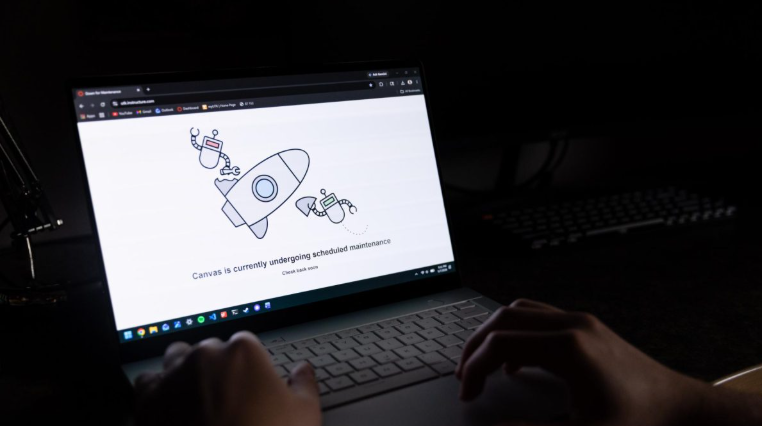
Students logging into Canvas this week expected the usual routine: unfinished assignments, lecture slides they forgot to read, maybe a last-minute plea from a professor about deadlines.
Instead, many were greeted with something far more alarming.
A stark message allegedly posted by the cybercrime group ShinyHunters warned schools to “pay or leak,” threatening to release data tied to thousands of educational institutions worldwide. Within hours, social media filled with panicked screenshots, confused memes and frantic student posts asking the same question: “Is Canvas down hacked?”
By Thursday morning, searches for terms like “canvas hacked,” “canvas down,” “shiny hunters,” “canvas reddit” and “did canvas get hacked” surged across the United States, reflecting a rapidly escalating cybersecurity crisis affecting schools during one of the worst possible moments of the academic year: finals season.
According to reports from Reuters, The Associated Press, Wired and TechCrunch, the learning management platform Canvas, operated by Instructure, suffered a major cybersecurity incident linked to the hacking group ShinyHunters. The disruption reportedly affected access to coursework, assignments, grades and internal communication systems used by universities and schools worldwide. (reuters.com)
A Finals Week Nightmare
At several universities, the outage felt less like a technical glitch and more like a digital earthquake.
Students at institutions including Harvard, UCLA, Duke and the University of Pennsylvania reported being locked out of coursework portals just as projects and final assessments were due. Some universities temporarily paused exams. Others rushed to distribute backup instructions through email and messaging apps.
“Canvas going down during finals week is basically the academic version of the apocalypse,” one student joked on Reddit.
Humour aside, the disruption exposed how deeply universities now depend on cloud-based education systems.
Canvas is not simply a website where professors upload PDFs anymore. For many institutions, it has become the operational backbone of modern education. Attendance records, quizzes, grades, assignment submissions, classroom discussions and direct messages often flow through the platform every day.
Industry estimates cited by multiple outlets suggest Canvas serves more than 30 million users globally across more than 8,000 institutions. (en.wikipedia.org)
That scale explains why searches for “canvas down hacked” exploded almost instantly after the outage began trending online.
Who Are ShinyHunters?
The name ShinyHunters may sound playful, almost like an online gaming clan. Cybersecurity experts say the reality is far darker.
The group has been linked to multiple high-profile data breaches involving major corporations and online platforms over recent years. Security researchers describe ShinyHunters as part of a wider ecosystem of financially motivated cybercriminals specialising in extortion and large-scale data theft.
In the Canvas incident, the hackers allegedly claimed to possess data connected to nearly 275 million individuals across approximately 9,000 schools worldwide. While those figures have not been independently verified, Instructure acknowledged that certain user information had been exposed. (theverge.com)
According to company statements and cybersecurity reporting, the compromised information may include:
- Names
- Email addresses
- Student identification numbers
- Internal communications and messages
Instructure said there was no evidence passwords, financial information or government identification numbers were compromised. (theverge.com)
Still, cybersecurity analysts warn that even limited academic data can become extremely valuable for phishing campaigns and identity fraud.
Why Students Should Take This Seriously
For many students, data breaches feel abstract until suspicious emails start arriving.
Cybersecurity experts warn that attackers often exploit panic after major hacks. Fake university notices, fraudulent password reset emails and phishing links commonly appear within days of public breaches.
The Centre for Cybersecurity Belgium advised affected users to remain alert for phishing attempts following the Canvas incident. (safeonweb.be)
That warning matters because educational accounts often connect to multiple services simultaneously, including university portals, cloud storage systems and even financial aid platforms.
A compromised student email can quickly become the starting point for wider attacks.
Practical steps students should take now
- Change your Canvas password immediately once systems stabilise.
- Use a unique password not shared with other services.
- Enable multi-factor authentication where available.
- Ignore urgent-looking emails demanding immediate action.
- Verify announcements directly through official university websites.
- Monitor university security updates over the coming weeks.
These simple actions dramatically reduce the risk of follow-up phishing attacks.
The Bigger Problem Facing Universities
The Canvas cyberattack highlights a growing issue across higher education: universities are becoming attractive targets for hackers.
Schools hold enormous volumes of personal data, yet many institutions still rely on aging IT infrastructure, fragmented security policies and limited cybersecurity budgets.
A 2025 global education cybersecurity survey by Sophos found that educational institutions remain among the most targeted sectors for ransomware and extortion attacks, partly because operational disruption creates immediate pressure to restore services quickly.
Hackers understand this pressure.
Disrupt a retailer and customers may complain.
Disrupt universities during finals week and entire campuses can grind to a halt.
That urgency becomes leverage.
The Canvas incident also reflects a broader shift in cybercrime tactics. Experts increasingly describe modern attacks as “leak extortion” rather than traditional ransomware. Instead of only encrypting systems, attackers steal large volumes of data first, then threaten public leaks to pressure organisations into negotiations.
Wired described the Canvas breach as part of a “new kind of ransomware debacle” where public pressure and operational chaos become weapons themselves. (wired.com)
Online Panic, Memes and Confusion
As the outage spread, so did online speculation.
Searches for “canvas reddit” and “is canvas hacked” surged as students tried piecing together information faster than official university notices could arrive.
Some users initially assumed the issue was a routine outage. Others believed they had forgotten passwords. Many discovered the truth only after screenshots of the alleged ShinyHunters message spread across X, Reddit and TikTok.
One viral post joked:
“The hackers saw my assignment grades and decided education itself needed to end.”
Another student wrote:
“Canvas being hacked during finals week feels like the universe giving everybody a group project in cybersecurity.”
Humour became a coping mechanism for genuine frustration.
For professors and administrators, however, the situation was far less amusing.
Several institutions scrambled to create emergency alternatives for assignment submissions and student communication. Some faculty reportedly reverted to email attachments and Google Drive folders, a reminder that even highly digitised education systems still depend heavily on contingency planning.
What Happens Next?
As of Friday, Canvas services were gradually returning for many institutions, though disruptions continued in some regions. Instructure said investigations remain ongoing while security teams work to contain the incident and restore systems fully. (theverge.com)
The long-term consequences may extend far beyond temporary outages.
Universities now face difficult questions:
- How much student data was actually exposed?
- Were third-party systems affected?
- Could future phishing attacks target students and staff?
- Are educational platforms prepared for increasingly aggressive cybercriminal groups?
For students, the lesson may be simpler.
The modern classroom no longer exists only inside lecture halls.
It lives online.
And increasingly, that makes education itself part of the global cybersecurity battlefield.