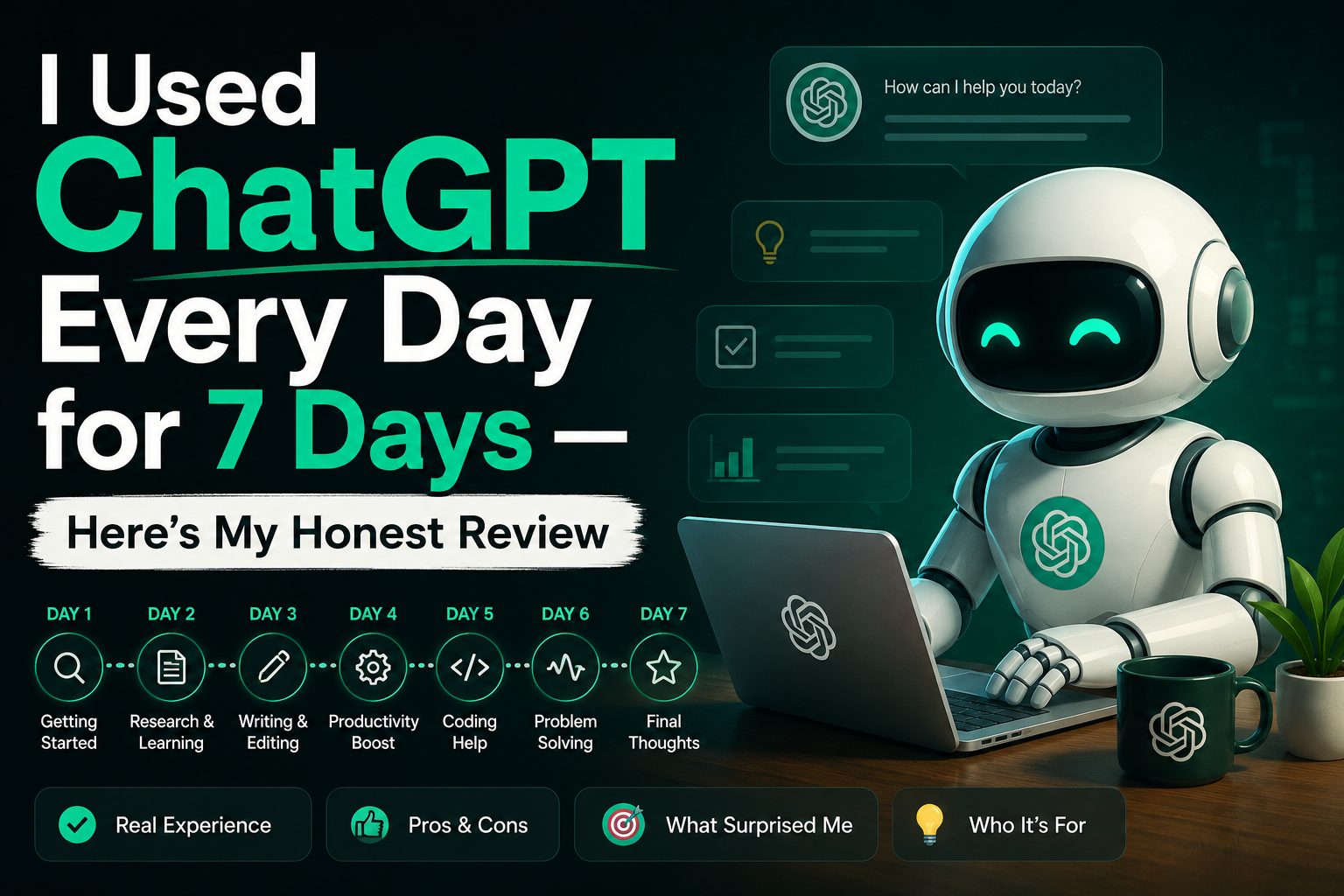
I’ll be honest — I was skeptical.
Everyone kept telling me ChatGPT would change the way I work. My colleague used it to write proposals. A friend said it helped him study for exams in half the time. So I decided to stop taking their word for it and test it myself.
For seven days, I used ChatGPT for real tasks I actually needed to get done. No cherry-picking easy wins. No skipping the frustrating parts. This is exactly what happened.
Day 1 — Writing a professional email I’d been avoiding
I had an email sitting in my drafts for three days. I needed to follow up with a client about a late payment but didn’t want to sound rude or desperate. I typed my situation into ChatGPT and asked it to write a polite but firm follow-up email.
It gave me three versions in about 8 seconds.
The first one was too formal. The second was almost perfect. I changed two sentences to match my tone and sent it. The client replied within an hour. Did ChatGPT help? Yes, genuinely. It didn’t write the perfect email, but it broke my procrastination and gave me a starting point I could actually use.
Day 1 verdict: Saved me about 25 minutes and one headache.
Day 2 — Summarising a long report
My boss sent a 34-page industry report and asked for a summary by end of day. I copied a few key sections into ChatGPT and asked it to summarise the main points in plain English.
This is where it genuinely impressed me. The summary was clean, accurate, and structured. I added my own observations about how it related to our work and sent it off. My boss said it was one of the clearest summaries I’d sent.
One warning though — don’t paste confidential company data into any AI tool. I used a public industry report. If your document contains sensitive information, don’t do this.
Day 2 verdict: Excellent for summarising public documents. Be careful with private ones.
Day 3 — Trying to get it to write a full article
This is where things got interesting. I asked ChatGPT to write a 1,000-word article on a topic in my field from scratch, with no guidance.
The result was technically correct but completely flat. It had no personality, no specific examples, and no voice. It read like a Wikipedia entry. If I had published it as-is, nobody would have read past the second paragraph.
What I learned is that ChatGPT is not a replacement for writing — it’s a writing partner. When I gave it an outline and asked it to expand specific sections, the quality improved significantly. But it still needed heavy editing to sound like a real person.
Day 3 verdict: Useful as a writing assistant. Useless as a ghostwriter you don’t edit.
Day 4 — Planning my week
I typed out everything I needed to do — deadlines, meetings, personal tasks — and asked ChatGPT to help me organise it into a realistic daily schedule.
It did a decent job. It grouped similar tasks, suggested blocking time for deep work in the morning, and even reminded me to include breaks. Nothing revolutionary, but genuinely helpful if you find planning overwhelming.
Day 4 verdict: A solid thinking partner for organisation. Won’t replace a proper planner app but useful for a quick sort.
Day 5 — Learning something new quickly
I needed to understand basic SEO for a project but had no time for a course. I asked ChatGPT to teach me the most important SEO concepts in simple language, then asked follow-up questions whenever something wasn’t clear.
This was one of the best uses I found all week. It felt like having a patient tutor who never got annoyed at my questions. In about 40 minutes I had a working understanding of something that would have taken me hours with YouTube videos.
Day 5 verdict: Outstanding for self-learning. One of the best use cases I tested.
Day 6 — Generating social media captions
I needed five Instagram captions for a project I was working on. I gave ChatGPT the topic, the tone I wanted, and the target audience.
The results were fine. Not brilliant, not terrible. Three of the five needed editing. Two I used almost unchanged. For someone who finds writing captions tedious, this would be a genuine time-saver. For someone who takes their brand voice seriously, it’s a starting point, not a finished product.
Day 6 verdict: Good for getting unstuck. Not good enough to publish without checking.
Day 7 — Asking it something it got wrong
On the final day I decided to test where it fails. I asked it a question about a recent news event. It gave me a confident, well-structured answer that was partially outdated. It stated old information as if it were current fact.
This is the most important thing I learned all week. ChatGPT does not know what happened recently unless it has web search enabled. It can sound completely sure about something that is no longer true. Always verify anything time-sensitive with a current source.
Day 7 verdict: Never trust it blindly for facts, current events, or statistics without checking.
My overall scores
| Task | Rating |
|---|---|
| Writing assistance | 8/10 |
| Summarising documents | 9/10 |
| Full article writing (unedited) | 4/10 |
| Planning and organisation | 7/10 |
| Learning new topics | 9/10 |
| Social media captions | 6/10 |
| Factual accuracy | 5/10 |
Is ChatGPT worth using in 2026?
Yes — but not in the way most people think. It won’t replace your judgment, your voice, or your need to verify facts. What it will do is save you time on the parts of work that feel slow and draining — first drafts, summaries, planning, and learning.
The people getting the most out of it are not the ones asking it to do everything. They are the ones who know exactly which part of their work to hand over, and which part to keep for themselves.
I’ll keep using it. But I’ll keep editing everything it gives me.
A few tips before you start
Be specific in your prompts. “Write me an email” gets a generic result. “Write me a polite follow-up email to a client who hasn’t paid in 30 days, keep it under 100 words” gets something usable.
Always read the output before using it. It sounds obvious but a lot of people don’t.
Use the free version first. For most everyday tasks it is genuinely enough.
Have you tried ChatGPT for your own work? What worked and what didn’t? Share in the comments below.